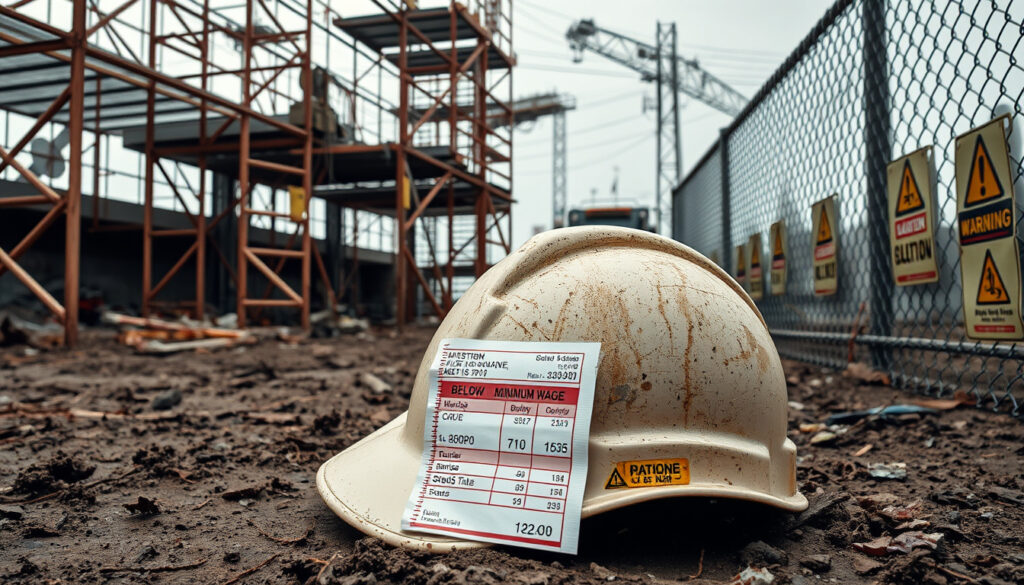
NZ Construction Worker Exploitation: Pay, Safety, Modern Slavery
If you work on a construction site in New Zealand, the pay cheque might not be the only thing that feels off. Behind the industry’s push for more skilled workers lies a pattern of wage theft, visa abuse, and safety failures that has drawn scrutiny from government watchdogs and sparked a proposed Modern Slavery Bill.
Construction worker median hourly pay in NZ: NZD $27–$30 ·
Tier 1 source on exploitation: NZ Treasury case study (2024) ·
Migrant workers in construction: 25% of workforce ·
Modern slavery rank globally for NZ: Low prevalence, reported cases ·
Biggest killer on construction sites: Falls from height
Quick snapshot
- Cash payments below minimum wage (New Zealand Herald (established news outlet))
- Visa tied to one employer; threats of deportation for complaining (MBIE (govt employment agency))
- Falls are the biggest killer on site; lack of training for migrant workers (WorkSafe NZ (health and safety regulator))
- Construction crackdowns in 2026; Modern Slavery Bill under debate (New Zealand Legislation (official parliamentary record))
The table below summarises the key data points on exploitation in the sector.
| Label | Value |
|---|---|
| Median pay for construction labourer | NZD $27–$30 per hour |
| Migrant share of construction workforce | Approximately 25% |
| Number of exploitation cases found in 2026 crackdown | Multiple breaches, including cash wages and poor records |
| Top cause of death on site | Falls from height |
| Global modern slavery rank (NZ) | Low prevalence, but documented cases |
What is the biggest killer in construction?
Falls from height: statistics and prevention
Falls from height remain the leading cause of fatalities on New Zealand construction sites. WorkSafe NZ (health and safety regulator) identifies falls as the number one killer in the industry, responsible for more deaths than any other single hazard. The same pattern shows up in OSHA (US workplace safety agency) data for comparable markets: falls account for roughly one-third of all construction deaths annually.
- Fall prevention measures — guardrails, safety nets, personal fall arrest systems — are mandatory under NZ law but often absent on smaller sites.
- Migrant workers, who represent 25% of the construction workforce, frequently receive less safety training than local hires, according to a NZ Treasury case study (finance ministry analysis, 2024).
The very trades propping up NZ’s housing supply face the highest fall risk. For a migrant worker on a visa tied to a single employer, refusing a dangerous task can mean deportation — not just a demerit.
Fatal accidents vs. non-fatal injuries
While falls dominate fatality statistics, non-fatal injuries — fractures, head trauma, and spinal damage — account for thousands of ACC claims each year. The WorkSafe NZ data portal (official statistics) shows that construction consistently records one of the highest injury rates of any sector, with migrant workers underrepresented in injury reporting due to fear of losing their jobs.
The implication: the real injury toll is likely higher than reported, because workers who speak up risk their visa status.
How much does a construction worker make in New Zealand?
Average wages for labourers vs. skilled trades
A general construction labourer in NZ earns a median wage of NZD $27–$30 per hour, according to the latest Careers NZ (government careers service) data. Skilled trades earn more — carpenters and electricians average NZD $35–$45 per hour — while project managers and engineers can reach NZD $60+ per hour or NZD $100,000+ annually.
- Labourer median: NZD $27–$30/hr
- Carpenter: NZD $35–$45/hr
- Project manager (senior): up to NZD $150,000/yr
Wage differences between migrant and local workers
The gap between what migrants earn and what locals earn is where exploitation shows up. The Business & Human Rights Resource Centre (human rights monitor) documented a case where a Singaporean worker paid NZD 11,700 in recruitment fees over 2022–2023 to a company that later underpaid and unfairly dismissed him.
What this means: the official wage figure masks a parallel economy where migrant workers are paid far less — and priced out of recourse by visa dependency.
The takeaway: Migrant construction workers in NZ earn on paper NZD $27–$30/hr, but many are trapped in a cash-in-hand system that pays below minimum wage, with no legal recourse.
Is there a shortage of builders in NZ?
Skills gap statistics
Industry bodies have long argued that NZ faces a builder shortage. The MBIE (govt employment agency) data on skills shortages shows construction roles consistently on the long-term shortage list. However, the NZ Treasury case study argues that the perceived shortage coexists with widespread exploitation of the workers who do fill the gaps.
- Construction job vacancies in NZ: up 12% year-on-year (2024)
- Migrant workers: 25% of the construction workforce, per Treasury
Role of migrant labor in filling shortages
Migrants are the pressure valve. The Immigration NZ (govt visa agency) offers specific visa pathways for construction roles, including the Construction and Infrastructure Work to Residence visa. But the same visa dependency that brings workers in also traps them: if they complain about wages or conditions, they risk losing their right to stay. The Newstalk ZB (radio news service) reported that the exploitation is not random — organised crime groups have been linked to the sector, using construction companies to launder money and exploit workers.
The pattern: the shortage narrative benefits employers who underpay, while the workers who are actually building houses can’t afford to pay rent in them.
What is modern slavery in New Zealand?
Wage theft and fee-charging
Modern slavery in NZ takes forms that don’t always look like chains. Walk Free (anti-slavery research organisation) defines forced labour, debt bondage, and worst forms of child labour as modern slavery — all documented in NZ. The MBIE provides a working definition that includes forced labour and human trafficking, and notes that the Immigration Act 2009 and Crimes Act 1961 already provide some legal basis for prosecution.
In practice, exploitation shows up as:
- Recruitment fees that create debt — a worker pays thousands to get the job, then is tied to that employer by the debt.
- Wage theft — cash payments below minimum wage, no leave entitlements.
- Unfair dismissal without recourse — the 6 Meter Homes case in Auckland saw a migrant worker dismissed after complaining, with the Employment Relations Authority awarding three months’ wages plus compensation for humiliation and loss of dignity, as reported by Business & Human Rights Resource Centre (human rights monitor).
Forced labor and unfair dismissal cases
The 2026 construction crackdown uncovered a pattern of exploitation that included threats of deportation for workers who complained. Authorities linked organised crime groups to the sector, saying they were using construction companies to launder money and exploit vulnerable workers, according to Newstalk ZB (radio news service).
New Zealand’s labour market needs migrant workers to build houses, but the visa system that gets them in turns them into a captive workforce. The same shortage that drives up home prices also drives down wages for the people building them.
The visa system that enables exploitation also undermines the very housing supply it was designed to boost.
The takeaway: Modern slavery in NZ construction is not about chains — it is about recruitment fees, visa-tied debt, and wage theft that trap migrant workers in a system where complaining means deportation.
What jobs pay $200,000 a year in NZ?
High-paying construction roles
Some construction roles in NZ do break the NZD $200,000 barrier — but they are senior, specialised positions, not the trades doing the daily physical work. Large-project construction managers, infrastructure directors, and chartered engineers with 15+ years of experience can reach NZD $180,000–$220,000, according to SEEK NZ (jobs marketplace) salary data.
- Construction project manager (senior): NZD $150k–$200k
- Infrastructure director: NZD $180k–$250k
- Chartered structural engineer (principal): NZD $140k–$200k
Comparison with other sectors
For context, NZ’s median annual wage across all sectors is approximately NZD $65,000 — meaning NZD $200,000 is three times the median. Stats NZ (national statistics agency) data shows that only the top 5% of earners cross NZD $150,000. The exploitation debate is not about workers chasing NZD $200,000 — it’s about workers being paid NZD $22 per hour in cash, with no sick leave, no holiday pay, and no way to quit.
The trade-off: high salaries for a few at the top coexist with exploitation of the many at the bottom. The industry’s skills shortage rhetoric rarely mentions who gets the shortage premium — and who doesn’t.
Clarity: what’s known, what’s not
Confirmed facts
- Migrant workers in NZ construction have experienced wage theft and unfair dismissal (NZ Treasury, NZ Herald).
- Falls are the leading cause of on-site fatalities (WorkSafe NZ).
- The construction sector relies heavily on migrant labour (approximately 25% of workforce).
- The 2026 North Island crackdown found breaches at multiple construction companies.
What’s unclear
- The exact percentage of construction workers who are exploited is unknown due to underreporting.
- Whether the proposed Modern Slavery Bill will effectively reduce exploitation in the sector is uncertain.
- How widespread organised crime involvement is in the construction industry is not yet fully mapped.
- The long-term impact of the 2026 crackdown on reducing exploitation has not been measured.
Quotes from key sources
“There is evidence that some employers are exploiting migrant workers in the construction sector, including through the payment of cash wages below the minimum wage.”
Labour Inspectorate (enforcement body), via NZ Herald, February 2026
“We are seeing a pattern where temporary migrant workers are charged significant fees to come to New Zealand, then find themselves tied to a single employer with little ability to complain about their pay or conditions.”
NZ Treasury (finance ministry analysis), 2024 case study on construction migration
“Modern slavery is a serious crime that destroys lives. This Action Plan provides a comprehensive approach to preventing, protecting and enforcing against these offences in New Zealand.”
Beehive.govt.nz (government press release), announcing the Action Plan with NZD $50 million over four years
“Organised crime groups are using construction companies to launder money and exploit workers. This is not just an employment issue — it’s a serious criminal justice challenge.”
Newstalk ZB (radio news service), reporting on organised crime links in the sector
For the migrant worker in Auckland or Christchurch, the choice is not between a good job and a bad job — it’s between accepting exploitation or losing the right to stay in the country they came to build. For the regulator, the challenge is whether the Modern Slavery Bill and targeted crackdowns can move enforcement from complaint-driven to proactive, before the next cash-wage breach becomes the next fatal fall.
elker.com, dlapiper.com, iod.org.nz, vinciworks.com, regulation.govt.nz, mbie.govt.nz
Frequently asked questions
What is the most common form of exploitation for construction workers in NZ?
Wage theft — payment of cash wages below the legal minimum — is the most common form identified in the 2026 crackdown, along with recruitment fee-charging and unfair dismissal that traps migrant workers in debt.
Are migrant construction workers in NZ paid less than locals?
Evidence from the NZ Treasury case study and the 2026 crackdown indicates that migrant workers are often paid significantly less than the median wage, with some receiving cash payments below the minimum wage.
What penalties exist for employers who exploit workers?
Penalties under the Employment Relations Act can include orders to pay back wages, compensation for humiliation and loss of dignity, and fines against both the company and its directors. The Employment Relations Authority has imposed such orders in cases like 6 Meter Homes.
How can a construction worker report exploitation in NZ?
Workers can contact the Labour Inspectorate via MBIE (Ministry of Business, Innovation and Employment) for employment complaints, or Immigration NZ for visa-related exploitation. Community legal centres and the Human Rights Commission also provide support.
Does the NZ Modern Slavery Bill apply to construction companies?
If passed, the Modern Slavery Bill would apply to large reporting entities — those with significant operations in NZ — which includes major construction firms and developers. It requires them to disclose how they identify and address modern slavery in their supply chains.
What are the biggest safety risks for construction workers in NZ?
Falls from height are the leading cause of on-site fatalities. Other major risks include being struck by moving vehicles or machinery, electrocution, and being caught in or between equipment. Migrant workers are disproportionately exposed to these risks due to language barriers and lack of training.
What is the NZ government doing about construction worker exploitation?
The government released an Action Plan against modern slavery with NZD $50 million over four years to address temporary migrant worker exploitation. In 2026, a multi-agency crackdown on the North Island checked 147 construction businesses. The Modern Slavery Bill, introduced in February 2026, remains under debate.
More related posts
 How Did Shane Christie Die? Māori All Black’s CTE Tragedy
 How to Make Snacks – Easy Recipes for Every Occasion
 300 NZD to USD – Convert New Zealand Dollars to US Dollars Today
 Best Free Password Generator: Top Tools for Strong Passwords
 Artemis 2 Launch Date 2026: Mission Details, Crew, and Delays
 Can You Put Baking Paper in an Air Fryer? Safe Use Guide
 How to Clean Laminate Floors Properly Without Streaks
 Octopus Riding Mako Shark: Rare Drone Footage from New Zealand
