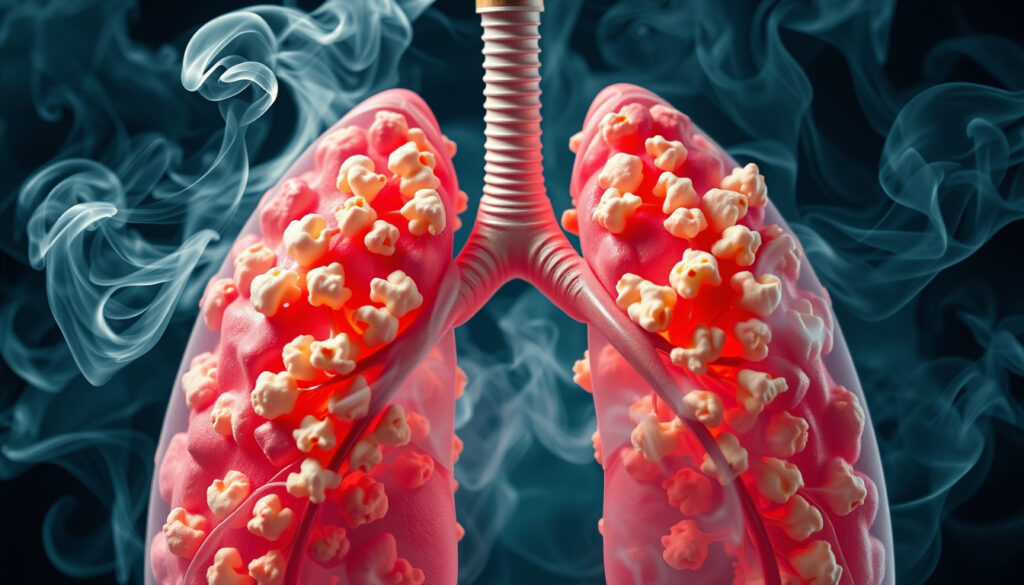
What Is Popcorn Lung? Symptoms, Causes & Vaping Risks
Diacetyl—the chemical that gives microwave popcorn its buttery flavor—has been conclusively linked to bronchiolitis obliterans, a serious and irreversible lung condition first identified in popcorn factory workers during the early 2000s. This article breaks down what popcorn lung actually is, what triggers it, and what the evidence says about the risks from vaping.
Medical name: Bronchiolitis Obliterans · Primary cause: Diacetyl exposure · Common trigger: Flavored e-cigarettes · Severity: Rare but irreversible · Key symptom: Persistent coughing
Quick snapshot
- Bronchiolitis obliterans (scarring in smallest airways) (Cancer Research UK)
- Diacetyl causes the scarring when inhaled (ScienceAlert)
- Damage is permanent—no full cure exists (Harvard Health)
- Exact rates of popcorn lung from vaping remain unknown (Cancer Research UK)
- Full recovery timelines after quitting are still debated (WebMD)
- Long-term studies on newer vape chemicals are limited (ScienceAlert)
- Term coined from popcorn factory workers, early 2000s (Cancer Research UK)
- EU banned diacetyl in e-liquids under TPD, 2016 (Cancer Research UK)
- EVALI outbreak peaked during 2019–2020 (Harvard Health)
- Researchers continue monitoring vaping’s long-term lung effects (Harvard Health)
- UK legal e-liquids no longer contain diacetyl post-ban (Cancer Research UK)
- Some US vape products may still carry diacetyl or substitutes (ScienceAlert)
The table below summarizes the core facts about popcorn lung, from its medical name to its connection with vaping.
| Fact | Detail |
|---|---|
| Disease name | Bronchiolitis Obliterans |
| Nickname origin | Popcorn factory workers |
| Main risk factor | Inhaled diacetyl |
| Prevalence | Rare |
| Reversibility | Irreversible scarring |
| Vaping link | Flavored e-cigarettes |
What are symptoms of popcorn lungs?
Popcorn lung damages the bronchioles—the tiniest airways in your lungs—and the resulting scar tissue progressively narrows these passages, making it harder to breathe. Symptoms typically surface within 2 weeks to 2 months after exposure to the triggering toxin.
Persistent coughing and wheezing
A dry, relentless cough is often the first warning sign. Wheezing follows, especially during physical activity or when breathing cold air. These symptoms mirror asthma or bronchitis, which is part of why popcorn lung gets missed. According to WebMD, patients describe the cough as irritating and non-productive—it doesn’t bring up mucus like a typical cold.
Shortness of breath
As the airways tighten, even mild exertion leaves you gasping. Climbing stairs, walking briskly, or carrying groceries becomes unexpectedly difficult. The American Lung Association highlights breathlessness as a hallmark symptom that worsens over time if the condition progresses.
Fatigue
When your lungs can’t deliver enough oxygen, your entire body feels the drag. Patients report lingering exhaustion that doesn’t improve with rest. Harvard Health notes that fatigue often accompanies the breathing difficulties, creating a cycle that limits physical activity further.
What causes popcorn lung?
The primary culprit behind popcorn lung is diacetyl, a chemical that tastes buttery and was once common in both microwave popcorn and some e-cigarette liquids. When inhaled in sufficient quantities, diacetyl triggers an inflammatory response that gradually scars the bronchioles.
Diacetyl in flavors
Diacetyl occurs naturally in fermented foods like cheese and butter, but it’s the synthetic version used in flavorings that poses the real risk. The American Lung Association warns that diacetyl has been found in flavored e-juices marketed as vanilla, maple, coconut, and butterscotch. The term “popcorn lung” itself comes from the early 2000s, when microwave popcorn factory workers began developing the condition from breathing in powdered diacetyl during production.
Vaping exposure
While diacetyl has been banned in UK e-liquids since 2016 under the EU Tobacco Products Directive, some products in other markets may still contain it. ScienceAlert reports that diacetyl substitutes like acetoin and 2,3-pentanedione may pose similar risks—and these chemicals haven’t been as thoroughly studied. Cancer Research UK confirms that there have been no confirmed cases of popcorn lung directly linked to e-cigarettes, though researchers flag the theoretical risk remains.
Other chemical inhalants
Beyond diacetyl, several other chemicals in vape aerosols have raised concern. Formaldehyde and acetaldehyde—both produced when e-liquid heats up—may contribute to airway irritation and scarring. ScienceAlert notes these volatile carbonyls are detected in the vapors released by certain devices, particularly those operating at high temperatures. Harvard Health experts identify a possible link between vaping and popcorn lung, citing diacetyl as the most direct concern.
Flavored vaping products were marketed as a “safer” alternative to smoking—but the evidence now shows that some flavor chemicals carry their own serious risks. The popcorn lung connection is the starkest example: one chemical that seemed innocuous (it’s used in food!) turned out to be a occupational hazard and, potentially, a consumer one.
What is popcorn lung from vaping?
When people ask about “popcorn lung from vaping,” they’re really asking whether e-cigarettes can cause the same condition that struck popcorn factory workers. The honest answer is nuanced: vaping products historically contained diacetyl, and that chemical is the proven cause of popcorn lung—but direct, confirmed cases from vaping remain absent in the medical literature.
Flavored e-cigarette risks
The appeal of flavored e-juice is also its potential hazard: flavors like vanilla, caramel, and fruit are created using compounds that, when heated and inhaled, may irritate lung tissue. The American Lung Association calls popcorn lung “a dangerous risk of flavored e-cigarettes,” though they acknowledge that confirmed cases from vaping haven’t been documented.
Diacetyl presence
Some e-cigarette e-juices have historically contained diacetyl at levels far below those that caused disease in popcorn factory workers. However, a reported US teenager case involved someone who developed popcorn lung after 3 years of secret vaping. The American Lung Association also points out that diacetyl was removed from major popcorn products once the connection became clear—but e-cigarettes have received less regulatory scrutiny in some markets.
Case evidence
No large-scale population studies have definitively proven that vaping causes popcorn lung. However, the 2019–2020 EVALI outbreak—which peaked during this period according to Harvard Health—showed that vaping-related lung injuries can involve bronchiolitis features. This suggests the link, while not confirmed, is biologically plausible. Summa Health emphasizes that the best prevention is avoiding vaping entirely.
The diacetyl question isn’t closed—it’s just poorly funded and under-studied. Absence of confirmed cases doesn’t mean absence of risk, especially when the mechanism of harm is well-established and some products may still contain the chemical.
Will popcorn lung go away?
Popcorn lung is irreversible. Once scar tissue forms in the bronchioles, it doesn’t dissolve or regenerate as healthy tissue. The condition can be managed, symptoms can be eased, and progression can sometimes be slowed—but the underlying damage is permanent.
Irreversible nature
Scar tissue in the lungs is permanent. Unlike muscle strains or liver inflammation, which can heal given time and treatment, damaged bronchioles lose their elasticity permanently. ScienceAlert confirms that popcorn lung cannot be cured, and Harvard Health describes it as irreversible with no full cure available.
Management options
Four main approaches help manage popcorn lung: corticosteroids like prednisone to reduce inflammation, bronchodilators such as albuterol to open airways, oxygen therapy to boost blood oxygen levels, and in severe cases, lung transplantation. Harvard Health Publishing lists all four as standard interventions. Pulmonary rehabilitation can also improve quality of life by helping patients build tolerance and breathe more efficiently.
No full cure
There’s no pill or procedure that can restore scarred bronchioles to their original condition. Early diagnosis is critical because prompt treatment with corticosteroids and immunosuppressants can slow further scarring. Allen Carr’s Easyway notes that early intervention is the best available strategy for limiting damage.
Is popcorn lung the same as COPD?
At first glance, popcorn lung and COPD look identical—cough, wheeze, breathlessness—but the two conditions differ in their anatomy, cause, and progression. Confusing them can delay the right diagnosis and the right treatment.
Key differences
Popcorn lung affects only the bronchioles, the tiniest airways, while COPD (chronic obstructive pulmonary disease) involves damage to the larger airways and lung sacs (alveoli) as well. WebMD describes popcorn lung as a restrictive condition where scar tissue physically narrows the small passages, whereas COPD is typically obstructive, involving airway collapse during exhalation. The damage patterns are fundamentally different.
Similar symptoms
Both conditions share a cluster of symptoms: chronic cough, wheezing, shortness of breath, and reduced exercise tolerance. Allen Carr’s Easyway points out that these similarities are why popcorn lung is often misdiagnosed as asthma or COPD initially. Pulmonary function tests can help distinguish between them, as each produces a characteristic pattern of airflow obstruction.
Distinct pathology
COPD usually develops over decades of smoking or long-term exposure to pollutants, while popcorn lung can develop within weeks to months of concentrated chemical exposure. The diseases also differ in that COPD is progressive but can sometimes be managed with bronchodilators and lifestyle changes, while popcorn lung scar tissue is fixed and unresponsive to standard COPD treatments. Harvard Health notes the EVALI cases from 2019–2020 showed bronchiolitis features similar to popcorn lung, underlining how vaping-related damage can mimic—but remain distinct from—COPD.
Long-term vapers presenting with breathing problems shouldn’t assume it’s just COPD from prior smoking. Patients should request specific testing for bronchiolitis obliterans—if the condition is caught early, treatment has a better shot at slowing progression.
What we know vs. what remains uncertain
Confirmed
- Diacetyl causes popcorn lung when inhaled at sufficient levels
- Popcorn lung is irreversible scarring with no cure
- Symptoms include cough, wheezing, breathlessness, and fatigue
- UK has banned diacetyl in e-liquids since 2016
- No confirmed popcorn lung cases from vaping—according to Cancer Research UK
Unclear
- Exact number of popcorn lung cases caused by vaping
- Whether diacetyl substitutes like acetoin cause the same damage
- How much lung function recovers after quitting vaping
- Whether the 2019–2020 EVALI cases were a preview of vaping’s long-term toll
What experts say
There have been no confirmed cases of popcorn lung linked to e-cigarettes.
— Cancer Research UK (cancer charity)
The American Lung Association has called popcorn lung ‘a dangerous risk of flavored e-cigarettes.’
— Harvard Health (medical editorial)
Popcorn lung can’t be cured, but treatments are available to slow its progression and ease symptoms.
— Harvard Health Publishing (medical editorial)
Diacetyl, though removed from some vape products, is still found in others.
— ScienceAlert (science journalism)
The bottom line is straightforward: diacetyl is the proven cause of popcorn lung, and while UK regulations have removed it from legal e-liquids, the same safeguards don’t exist everywhere. For vapers outside regulated markets, the risk isn’t theoretical—it hinges on what’s actually in their product. Quitting vaping eliminates exposure entirely, and that is the only step that guarantees the damage can’t start or worsen.
Related reading: Sore Throat Causes and Remedies
Popcorn lung’s irreversible damage echoes the Ben Askren lung transplant former UFC fighter Ben Askren faced after a devastating infection.
Frequently asked questions
Is popcorn lung curable?
No. Popcorn lung cannot be cured. Scar tissue in the bronchioles is permanent. Treatment focuses on managing symptoms and slowing further progression through corticosteroids, bronchodilators, oxygen therapy, or in severe cases, lung transplant.
Is popcorn lung dangerous?
Yes. Popcorn lung is a serious, irreversible condition that progressively narrows the smallest airways. Without treatment, it can lead to severe breathing difficulties and respiratory failure.
How rare is popcorn lung?
Popcorn lung is considered rare. Most documented cases come from occupational exposure in popcorn factories. Confirmed cases from e-cigarette use have not been reported in the medical literature, though the theoretical risk remains.
Is popcorn lung permanent?
Yes. Once scar tissue forms in the bronchioles, it does not heal or regenerate. The damage is permanent, and any reduction in lung function is likely lifelong.
Can your lungs heal from vaping?
Some lung damage from vaping may improve after quitting, but it depends on what damage has occurred. The lungs have limited capacity to repair scarring. Early-stage irritation may resolve, but established popcorn lung scarring will not.
Is 100 puffs of a vape a day bad?
While no safe level of vaping is established, high-frequency use increases exposure to flavor chemicals, including potentially harmful ones like diacetyl. Even with regulations in place, heavy use carries cumulative risk.
How do I tell if I got popcorn lungs?
Popcorn lung is diagnosed through pulmonary function tests, high-resolution CT (HRCT) scans, and sometimes a lung biopsy. If you have a persistent dry cough and breathing problems after vaping or chemical exposure, see a pulmonologist and mention your history explicitly.
How long does it take your lungs to heal from vaping?
Recovery timelines vary. If lung damage hasn’t reached scarring, some improvement may occur within weeks to months of quitting. However, established popcorn lung damage is permanent, and any healing caps out at the level of remaining healthy tissue.
More related posts
 Chicken Fried Rice Recipe – Ready in 20 Minutes
 Can I Use Body Wash as Hand Wash? Safety & Skin Tips
 US Dollars to NZ Dollars: Exchange Rate & Conversion Tips
 Outdoor Security Cameras NZ: Best Picks & Buyer’s Guide
 How Old Is Sabrina Carpenter? Age, Real Name, and Facts
 FIFA World Cup European Qualifiers 2026: Groups & Schedule
 Can You Take Aerosols in Checked Baggage in NZ? Rules & Limits
 Harvey Norman Duvet Covers: Best Picks & Buyer’s Guide
