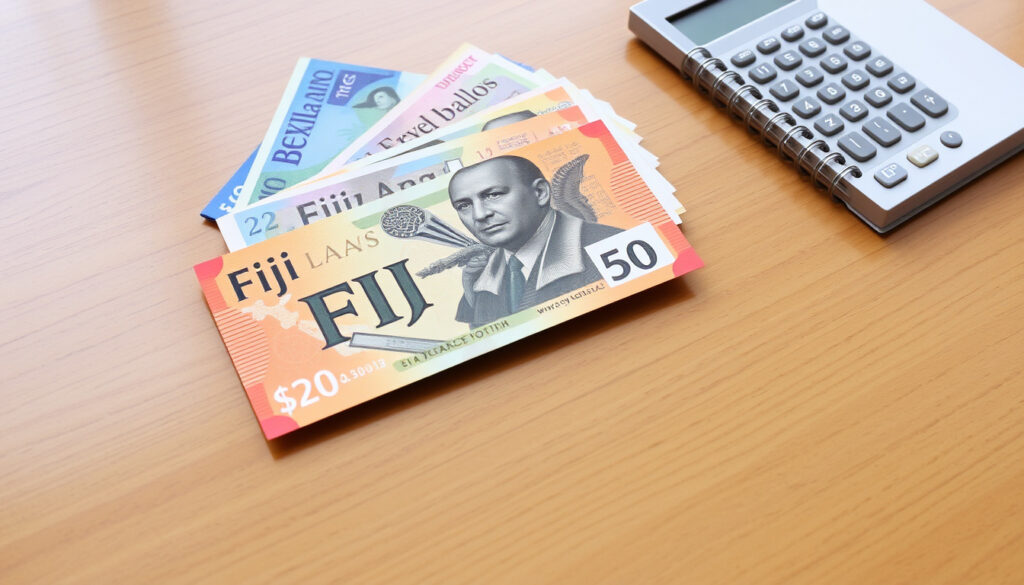
Fiji Currency to NZD: Exchange Rate & Travel Budget
There’s a moment every New Zealander planning a Fiji trip faces: you’ve booked the flights, packed the togs, and then it hits you — what currency should you actually take? With 1 Fijian dollar worth roughly 0.76 NZD, the numbers matter, but so do the local quirks of cash acceptance. This guide breaks down the real exchange rate, where your NZD is welcome, and what a week in paradise actually costs in your home currency.
Mid-market exchange rate (FJD to NZD): 1 FJD = 0.7619 NZD (as of April 2026) ·
Mid-market exchange rate (NZD to FJD): 1 NZD = 1.3125 FJD ·
100 New Zealand dollars in Fijian dollars: 100 NZD ≈ 131.25 FJD ·
100 Fijian dollars in New Zealand dollars: 100 FJD ≈ 76.19 NZD ·
Average cup of coffee in Fiji: 5–7 FJD (approx 3.80–5.33 NZD)
Quick snapshot
- Fiji Dollar (FJD) is the sole legal tender in Fiji (Reserve Bank of Fiji (central bank)).
- Mid-market rate: 1 FJD ≈ 0.7619 NZD (OFX (forex specialist)).
- Exact merchant acceptance rates for NZD vary by location and season.
- Actual conversion margins at hotels vs banks can differ significantly.
- Some tourist resorts and shops accept NZD, but at poor rates.
- Low season (Nov–Apr) offers cheaper flights and accommodation.
- FJD/NZD hit a 2026 high of 0.7767 on 13 March 2026 (ValutaFX (currency data aggregator)).
- The 2026 average is 0.7643; the worst rate occurred 25 Jan 2026 at 0.7457 (Exchange Rates UK (rate archive)).
- Forecasts suggest FJD/NZD could decline to 0.7500 by end of 2026 (CoinCodex (forex forecasting service)).
Six key currency facts, one pattern: the actual buying power of your NZD in Fiji depends heavily on where and how you exchange.
| Label | Value |
|---|---|
| Fijian dollar currency code | FJD |
| New Zealand dollar currency code | NZD |
| Mid-market rate (FJD to NZD) | 0.7619 (April 2026) (OFX) |
| Mid-market rate (NZD to FJD) | 1.3125 |
| Acceptance of NZD in Fiji | Limited; official currency is FJD |
| Best currency to bring | Fijian dollars (FJD) |
How much is $100 New Zealand in Fiji?
At the mid-market rate, $100 NZD converts to approximately 131.25 FJD (OFX (forex specialist)). That buys a decent dinner for two at a mid-range restaurant or a full day’s island-hopping tour. But if you rely on hotel currency desks, you might receive only 125–128 FJD because of commission and markups.
How much is $100 Fiji in NZ?
- Inverse conversion: 100 FJD = 76.19 NZD (based on OFX mid-market rate).
- That’s roughly the price of a petrol tank fill for a small car back home.
Current exchange rate trends
The FJD/NZD rate has fluctuated in 2026. According to ValutaFX (currency data aggregator), the highest rate so far was 0.7767 on 13 March 2026, while the lowest was 0.7457 on 25 January 2026 (Exchange Rates UK (rate archive)). The 2026 average sits at 0.7643. For travellers, timing a bulk exchange near a rate peak can save 3–4% on spending money.
The implication: even a small move in the rate can change your effective budget by NZD 30–50 on a week’s spending of about 1,000 FJD.
1 FJD = 0.7619 NZD using the current mid-market rate.
— Xe.com (currency data provider)
Can we use NZ dollars in Fiji?
Short answer: sometimes, but not wisely. The Fiji Dollar (FJD) is the only legal tender (Reserve Bank of Fiji (central bank)). However, some tourist resorts, dive shops, and larger souvenir outlets accept NZD at an often unfavourable rate — typically 10–15% worse than the mid-market rate.
Where NZ dollars are accepted
- Resort front desks (but rates are poor — expect a 10–20% haircut).
- Some airport shops and duty-free outlets.
- Larger hotels in Nadi and Denarau.
Disadvantages of using NZD
- You lose 10–15% on the spot compared to exchanging to FJD first.
- Change is given in FJD at the merchant’s rate — so you get hit twice.
- ATMs do not dispense NZD; they give FJD.
- Many small markets and local eateries will not accept foreign cash.
The trade-off: using NZD directly may feel convenient, but it silently inflates your spending by roughly the cost of one extra meal per day.
A cup of coffee in Fiji typically costs between $5 and $7 FJD.
— Fiji Pocket Guide (travel resource)
What is the best currency to take to Fiji?
FJD is the straightforward winner. The Reserve Bank of Fiji (central bank) pegs the FJD to a basket of currencies, including the NZD, so the official rate is set daily and is relatively stable. Bringing NZD cash and relying on exchange counters is not optimal.
Cash vs card vs traveler’s checks
- Cash (FJD): essential for street food, taxis, villages, and small shops.
- Credit card: widely accepted in hotels, resorts, and larger restaurants, but check for foreign transaction fees (typically 1–3% from NZ issuers).
- Traveler’s checks: obsolete — hardly anyone honours them anymore.
When to exchange money
Exchange your NZD to FJD at a bank or licensed bureau in Fiji (such as ANZ or Westpac branches) for the best rates. Airport exchange kiosks and hotel desks tend to charge higher spreads. According to Wise (money transfer platform), the live mid-market rate (as of late April 2026) is around 0.7515 FJD per NZD, so a 1% margin is a fair target.
Why this matters: exchanging NZD 500 at a 3% margin vs 1% costs you NZD 10 — that’s a coffee and a pastry you could have enjoyed at a Suva cafe.
New Zealand travellers face a clear choice: exchange to FJD before or upon arrival, or pay a 10–15% convenience premium by using NZD directly. The difference on a week’s budget of NZD 1,200 could be NZD 120–180 — enough for a full day excursion.
Is $1000 enough for a week in Fiji?
$1,000 NZD converts to about 1,312 FJD at the mid-market rate (OFX). That covers a tight but doable week for a budget traveller. Let’s break it down.
Average daily costs for a traveller
- Budget style (hostels, street food, no tours): 150 FJD/day (~115 NZD).
- Mid-range (3-star hotel, restaurant meals, some activities): 300–400 FJD/day (~230–305 NZD).
- Luxury (resort, fine dining, private excursions): 800+ FJD/day.
Sample 7-day budget breakdown
- Accommodation: 400–1,200 FJD for the week.
- Food & drink: 200–500 FJD (street food: 10–15 FJD/meal; restaurant: 30–60 FJD/meal).
- Transport & activities: 200–600 FJD.
- Miscellaneous: 100–200 FJD (coffee, snacks, tips).
The pattern: even with careful budgeting, costs vary significantly, but $1000 NZD covers a modest week if you exchange wisely.
What is the cheapest month to go to Fiji?
The low season in Fiji runs from November to April, with the cheapest months typically February and March. During this period, flights and accommodation often see discounts, though the risk of cyclones is higher. Travelers seeking lower costs should consider these months, though currency movements can also affect the total outlay.
Seasonal price patterns
According to industry travel guides, hotel rates can drop by 30–50% compared to peak season (June–August). Availability and weather should be weighed.
Weather considerations
The wet season brings more rain and potential storms. Travel insurance is recommended.
If you’re flexible, February often offers the lowest prices, but check cyclone forecasts before booking.
The takeaway: low-season travel can stretch your NZD further, especially if you also exchange at a favourable rate.
Before you finalise your travel budget, check the current FJD to NZD exchange rate to see how far your New Zealand dollars will stretch in Fiji.
Frequently Asked Questions
Can I use Australian dollars in Fiji?
Some tourist businesses accept AUD at poor rates, but FJD is the only legal tender. It’s best to exchange AUD to FJD before spending.
Is it better to exchange money before travelling to Fiji?
Exchanging in Fiji (at banks or licensed bureaus) usually gives better rates than NZ currency exchanges. Avoid airport kiosks and hotel desks.
Do ATMs in Fiji dispense NZ dollars?
No, ATMs in Fiji dispense only FJD. You can withdraw FJD using your NZ bank card, but foreign transaction fees may apply.
Are credit cards widely accepted in Fiji?
Major hotels, resorts, and larger restaurants accept credit cards. Smaller shops, markets, and street vendors prefer cash (FJD).
How much cash should I bring to Fiji for a week?
For a budget week, about 700-1000 FJD in cash (for small purchases) plus a card for larger expenses. This varies by spending style.
Can I pay with New Zealand bank cards in Fiji?
Yes, most EFTPOS and credit cards work, but you may incur foreign transaction fees (1-3%). Notify your bank before travelling.
More related posts
 Watch All Blacks Live: Free Streams, TV Channels & Schedules
 Indian Videographer Near Me: Costs, Tips & How to Hire in Ireland
 What Is REM Sleep? Definition, Stages, and Why It Matters
 Wellington Airport Taxi Ride Refusals: Rules, Costs & Reporting
 Today’s Gold Price in India: 24K, 22K Rates per Gram & Tola
 Natural Shampoo and Conditioner: Ireland’s Top Picks
 Oppenheimer (Film): Accuracy, Controversies & Cast Walkout
 Another Word for Significant: 230+ Synonyms & Alternatives
