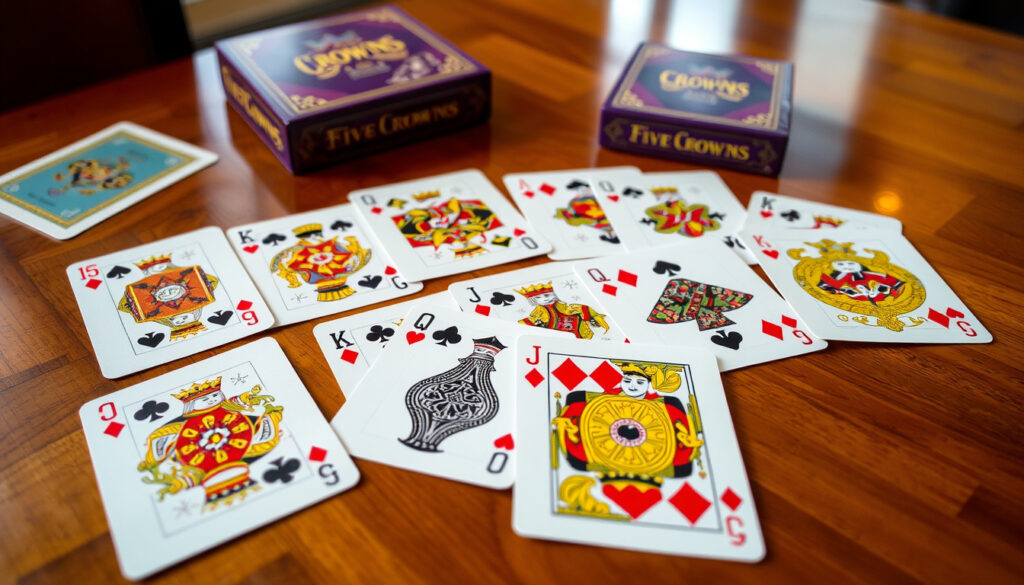
Five Crowns Card Game: Rules, Strategy & How to Play
Five Crowns has been a fixture at family game nights since 1996, showing up on shelves with its cheerful crown logo and promising something familiar yet strangely fresh. What sets it apart from the rummy games you already know is a deceptively simple twist: instead of one or two suits, you get five — and the wild card rotates every round. By the time you reach the Kings, nearly every card in your hand has the potential to save you or sink you. That escalating tension is exactly why players keep coming back.
Suits: 5 (stars, hearts, clubs, spades, diamonds) · Cards per deck: 58 · Jokers per deck: 3 · Hands per game: 11 · Wild card rank: Rotates each hand (3 to King)
Quick snapshot
- Five Crowns combines elements of Rummy and Phase 10 (Wikipedia)
- Two 58-card decks shuffled together create 116 total cards (PlayMonster Rules PDF)
- Jokers score 50 points if unmelded at round end (Cardanoir)
- Exact solitaire rules variations between printings
- Advanced solitaire win-rate data or performance benchmarks
- First published by Set Enterprises in 1996 (Cardanoir)
- PlayMonster Rules PDF uploaded in September 2019 (PlayMonster)
- Newcomers can expect to grasp basic play in under 10 minutes
- Strategy mastery takes several games as wild-card dynamics shift each round
| Label | Value |
|---|---|
| Publisher | PlayMonster (SET Enterprises) |
| Player Count | 2-7 |
| Play Time | 30 minutes |
| Age | 8+ |
| Rounds | 11 |
| Total Cards | 116 |
| Joker Penalty | 50 points |
| Wild Card Value | 20 points |
How do you play the 5 Crowns card game?
The core loop follows classic rummy logic — draw, meld, discard, repeat — but the five-suit deck and rotating wilds introduce a layer of strategy that surprises newcomers who expect a simple children’s game.
Setup
Shuffle two standard 58-card decks (with three Jokers each) together. The combined deck holds 116 cards spanning five suits: stars, hearts, clubs, spades, and diamonds. Ranks run from 3 through King; Aces and 2s are absent entirely. Deal face-down to each player, one card at a time, starting with the player to the left of the dealer. In round one, everyone receives 3 cards; round two brings 4 cards, and so on, adding one card per round until round 11, when each player holds 13 cards.
The remainder of the deck sits face-down as the draw pile, with the top card turned beside it to start the discard pile. That first discard card stays in play — anyone may pick it up on their turn.
Five Crowns officially supports 2–7 players, but the rulebook notes that two copies of the deck allow up to 14 players (Cardanoir). This scalability makes it a reliable choice for larger family gatherings where player counts fluctuate.
Dealing and gameplay
Each turn, a player draws either the top deck card or the top discard pile card, then discards one card face-up. The critical restriction: you cannot meld any cards until you are ready to “go out” — that is, lay down every card in your hand as valid books or runs. Partial melds are not permitted in multiplayer play.
Books require three or more cards of the same rank, regardless of suit. Runs demand three or more sequential cards of the same suit. Wilds and Jokers fill gaps in runs; books can mix suits freely as long as ranks match. Once a player discards their final card and declares “out,” play stops. All opponents receive one last turn to meld or attach cards to existing groups on the table before scoring begins.
Going out and scoring
At round’s end, count only the cards still in your hand. Number cards retain face value (5 = 5 points), Jacks cost 11, Queens 12, Kings 13, wild cards 20, and Jokers a punishing 50. The player with the lowest total after 11 rounds wins. The rulebook’s official hint captures the philosophy: “Keep your options open. You can come from behind even in the last round.”
What is the best strategy in 5 crowns?
Experienced players develop instincts that evolve across the 11 rounds, but three recurring priorities separate consistently strong performances from lucky wins.
Early game priorities
- Discard high cards early. Kings, Queens, and wild cards lingering in your hand accumulate points fast. If they don’t immediately fit into a potential meld, drop them on the discard pile before they become liabilities.
- Keep runs flexible. With five suits, the odds of completing a run feel lower than in standard rummy. Target books when possible — they require only rank matching, not suit sequences.
- Watch the wild card rank. Knowing which rank is wild this round shapes your entire hand evaluation. A 7 wild in round five means 7s lose their scarcity; pivot accordingly.
Managing discards
- Track what opponents pick up. If an opponent reaches for a 6 from the discard pile, they may be building a run of 4-5-6 in that suit. Feeding them the 7 could backfire.
- Control the discard pile’s top card. A discard pile you control denies opponents a free draw while keeping your options open.
- Don’t hoard Jokers. At 50 points each, unmelded Jokers can devastate a round score. Meld them as soon as a valid book forms, even if it means breaking a potential longer run.
Fantastic Games notes that “the game rewards patience and timing over aggression” — a philosophy backed by the scoring structure where going out first locks in a zero for that round regardless of how many cards others hold.
Endgame optimization
Late rounds (9–11) feature 11–13 cards per hand and Kings wild. The wild card expansion means nearly every card qualifies as useful, but it also means opponents hold dangerous combinations. Prioritize closing out clean: reduce your hand to a single meld plus one discardable card. If you’re ahead on points, play defensively — force others to take risks. If you’re behind, aggression pays off; swing for the zero and let others accumulate.
Is 5 crowns the same as gin rummy?
Both games belong to the rummy family and share the draw-discard-meld loop, but Five Crowns diverges in ways that change the strategic landscape entirely.
Key similarities
- Draw one, discard one per turn
- Form sets (books) or sequences (runs)
- Lowest score at game’s end wins
- Opponents get a final turn after someone goes out
Major differences
| Feature | Gin Rummy | Five Crowns |
|---|---|---|
| Suits | 4 (standard) | 5 (adds stars) |
| Wild cards | None (or optional) | Rotating rank + Jokers always wild |
| Rounds | Single hand | 11 hands, escalating size |
| Partial melds | Allowed | Not permitted until going out |
| Card range | Ace low through King | 3 through King (no Aces or 2s) |
The five-suit structure dramatically expands run possibilities — a straight in Five Crowns can be 3-4-5 in any of five suits — but the absence of Aces and 2s means the low end of sequences is permanently capped at 3.
Wikipedia confirms Five Crowns “combines elements of Rummy and Phase 10,” borrowing Phase 10’s multi-round progression. The escalating hand size across 11 rounds creates a marathon format that gin rummy’s single-hand structure simply cannot replicate.
Is Five Crowns a good card game?
Cardanoir’s reviewer captured the consensus well: “Among modern family card games, few titles carry a reputation as warm, reliable, and surprisingly deep as Five Crowns.” That combination of accessibility and hidden complexity explains its staying power since 1996.
Pros and cons
Upsides
- Age range spans 8+ to adults without feeling
- 11-hand structure ensures every game feels different
- Rotating wilds keep strategy fresh across rounds
- Scales to 2–14 players with deck adjustments
- Solitaire variant extends replay value to solo players
- Quick setup: shuffle two decks, deal, play
Downsides
- Five suits can overwhelm newcomers at first
- No partial melds slows early-round experimentation
- Jokers at 50 points create high-variance rounds
- Card counting across 5 suits demands more mental effort
- Not a quick game — expect 30–45 minutes minimum
Who it’s for
Five Crowns sits comfortably between casual family fun and strategy-focused game nights. Families with children aged 8+ appreciate the straightforward rules; seasoned card gamers enjoy the rotating wild mechanics that force constant recalculation. It functions equally well as a travel game (two decks compact easily) or a centerpiece for longer sessions.
Can one person play 5 crowns?
Yes — Five Crowns Solitaire offers a solo challenge that mirrors the multiplayer version’s escalating tension while introducing mechanics that work only in isolation.
Solitaire rules
The Set Enterprises Solitaire Instructions PDF (tier 1 source) defines the setup precisely: deal 11 face-up piles arranged in a row. The first pile holds 3 cards, the second 4, continuing through to the eleventh pile with 13 cards. A 12-card draw pile sits beside the rightmost pile.
Gameplay proceeds by drawing the top card from the draw pile, placing it on any open pile (not yet closed), then discarding one card from the pile you just touched. Wilds are pile-specific: the 3-card pile treats 3s as wild, the 4-card pile treats 4s as wild, and so on through Kings for the 13-card pile. Jokers remain always-wild regardless of pile.
- Close a pile by forming a valid book or run using all its cards
- Closed piles flip face-down and cannot be reopened
- Cards cannot move between piles — each pile is an independent puzzle
- Win by closing all 11 piles before the draw deck empties
- Lose if the draw deck runs out before all piles close
Single-player adaptations
Some players experiment with a “practice mode” where they deal all 116 cards into 11 piles without a draw deck and attempt to close each pile using only internal rearrangements. This variant sacrifices the draw-pile tension but serves as a pure optimization puzzle. YouTube tutorials (tier 3) demonstrate pile-arrangement strategies that help players visualize run potential across the five suits.
The pile-specific wild mechanic adds a layer absent from multiplayer: a 7 gathering dust in the 5-card pile suddenly becomes valuable when the 5s are wild there, but worthless if that pile already has a near-complete run. This dynamic demands constant reassessment that multiplayer simply doesn’t require.
Five Crowns Solitaire vs Multiplayer: Key Differences
The structural divergence between these modes reshapes the entire strategic approach.
| Element | Multiplayer | Solitaire |
|---|---|---|
| Structure | Shared draw and discard pile | 11 independent face-up piles |
| Wilds | Entire rank per round | Pile-specific rank per pile |
| Card movement | Any valid meld, any time | No pile-to-pile transfers |
| Win condition | Lowest score after 11 rounds | Close all piles before deck empties |
| Turn structure | Draw → play → discard | Draw to pile → discard from same pile |
| Partial melds | Not permitted | N/A (no opponent interaction) |
| Player interaction | Discard pile theft, final turn racing | None — pure puzzle |
The implication: multiplayer rewards reading opponents and timing your exits, while solitaire rewards spatial reasoning and pile-priority management. The solitaire variant transforms Five Crowns from a social negotiation game into an optimization challenge.
How Five Crowns Stacks Up Against Family Card Games
This comparison places Five Crowns alongside other popular family card games to highlight its distinctive features.
| Game | Suits | Rounds | Wilds | Players | Solo Mode |
|---|---|---|---|---|---|
| Five Crowns | 5 | 11 | Rotating + Jokers | 2–14 | Yes |
| Gin Rummy | 4 | 1 | None/optional | 2 | Limited |
| Phase 10 | 4 | 10 | Wild_skip | 2–6 | No |
| Rummy 500 | 4 | 1 | None | 2–6 | Limited |
| Canasta | 4 | Open-ended | Wild threes | 2–6 | No |
Five Crowns stands out for its combination of extended round structure and rotating wild system — a pairing no other family card game in this comparison replicates. The five-suit deck further distinguishes it, particularly for run-seekers who enjoy longer sequences than standard four-suit games allow.
Related reading: Is Qi a Scrabble Word? Official Validity, Points & Rules
youtube.com, www2.parklanejewelry.com, setgame.com, alibaba.com, fantasticgames.com, playmonster.com, scribd.com
Frequently asked questions
Do you shuffle every time in Five Crowns?
Yes. Each round begins with a fresh shuffle of the combined 116-card deck. The discard pile from the previous round does not carry over — all cards return to the deck before the next deal.
What are the rules for Five Crowns card game?
Players draw one card, discard one card per turn, and must meld all cards simultaneously when going out. Books require 3+ same-rank cards; runs require 3+ sequential same-suit cards. Wilds and Jokers fill gaps. Scoring penalizes leftover cards by face value, with wilds at 20 and Jokers at 50.
How many players for Five Crowns?
The official range is 2–7 players with one deck. Using two decks extends play to 14 players. A solitaire variant accommodates single players.
Are Jokers wild in Five Crowns?
Yes. Jokers are always wild in both multiplayer and solitaire variants, regardless of the round’s rotating wild rank. Holding an unmelded Joker at round’s end costs 50 points.
How does the wild card change in Five Crowns?
Each round, a different rank becomes wild equal to the hand size. Round 1 uses 3s wild (hand size = 3), round 2 uses 4s wild (hand size = 4), continuing through round 11 where Kings are wild (hand size = 13). The slogan “The Game Isn’t Over ‘Til the Kings Go Wild!” refers to this final-round shift.
What is the scoring in Five Crowns?
Number cards score face value. Face cards: Jacks = 11, Queens = 12, Kings = 13. Wild cards = 20 points each. Jokers = 50 points each. Players with the lowest total after 11 rounds win. Ties are resolved as co-winners or a 6-card tie-breaker round.
Five crowns card game online free?
Free digital versions vary by platform. The official Set Enterprises and PlayMonster websites do not host a free online client as of this writing. Some third-party sites and apps offer browser-based play, but availability and rule accuracy cannot be guaranteed.
Where to buy Five Crowns card game?
The game is sold through major retailers including Amazon, Walmart, and Target, as well as specialty game stores. It typically retails for $12–15 USD. Verify the publisher is PlayMonster (formerly SET Enterprises) to ensure authentic rules and components.
What players and reviewers say
“The Game Isn’t Over ‘Til the Kings Go Wild!”
— Five Crowns Official Slogan (Wikipedia)
“Among modern family card games, few titles carry a reputation as warm, reliable, and surprisingly deep as Five Crowns.”
— Cardanoir (Cardanoir Game Review)
“Keep your options open. You can come from behind even in the last round.”
— Official Five Crowns Rulebook (Five Crowns Rulebook PDF)
Five Crowns earned its reputation the hard way — through genuine replay value rather than marketing. The rotating wild system ensures that every hand reshapes the strategic landscape, forcing players to abandon fixed plans and adapt. For families seeking a game that grows with them, the 11-round structure means the third play feels meaningfully different from the first. For solo players, the solitaire variant delivers the same core mechanics in a self-contained puzzle that can occupy an evening just as easily as a 15-minute break. The one thing it demands is attention: the five suits and escalating hand sizes create complexity that rewards focus.
More related posts
 IRD Tax Compliance Warning: Red Flags, Audits & Penalties
 How to Clean Bamboo Flooring: Safe Tips & Best Cleaners
 SBS Term Deposit Rates: NZ Comparison & Latest Offers
 Calculate Mortgage Repayments in NZ: Top Bank Tools
 What Is Popcorn Lung? Symptoms, Causes & Vaping Risks
 How Old Is Sabrina Carpenter? Age, Real Name, and Facts
 Netherby Fish and Chips Ashburton: Menu & Local Reviews
 ANZ Floating Interest Rate 2026: Current Rate, Increase, and Impact
