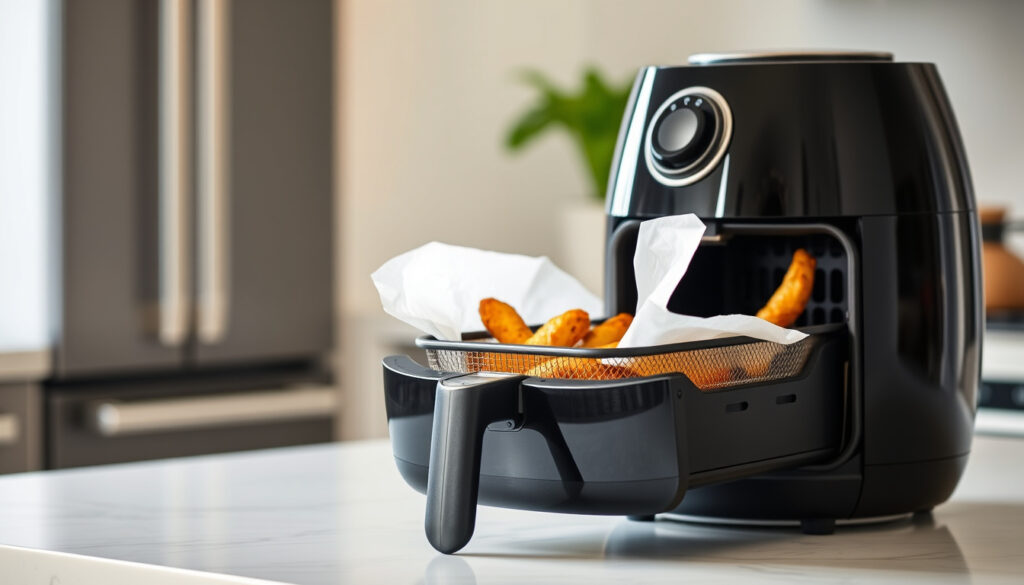
Can You Put Baking Paper in an Air Fryer? Safe Use Guide
Standing in front of a hot air fryer with a sheet of baking paper in your hand, the risk is easy to brush off—it shouldn’t be. Baking parchment is safe in some air fryers, but only when the appliance maker permits it and the sheet stays clear of the heating element, according to Reynolds Brands (parchment maker). Temperature ratings, airflow, and the liner you choose decide whether cleanup gets easier or dinner gets interrupted.
Maximum temperature for standard parchment paper: 450°F (232°C) ·
Typical air fryer maximum temperature: 400°F (200°C) ·
Recommended air fryer liner material: Silicone or perforated parchment paper
Quick snapshot
- Perforated air-fryer liners preserve airflow, unlike a solid sheet of paper (aircook.app (air fryer cooking app)).
- Liner heat ratings are not universal — always check the product’s stated limit (Microplastics App (liner safety blog)).
- Food should weigh the paper down on all sides before cooking begins (Reynolds Brands (parchment maker)).
- Whether every parchment brand uses the same food-grade silicone coating — release agents differ. (Quinnoa (air fryer guide))
- Which brand-specific air-fryer liners hold up across repeated high-heat use. (Quinnoa (air fryer guide))
- Whether some Philips guidance against parchment and foil applies to every model (Quinnoa (air fryer guide)).
- Basket design and heater position differ by model — the manual outranks generic advice. (Must Kitchen Beast (appliance blog))
- Paper liners are single-use; silicone liners are built for repeated cooks (Must Kitchen Beast (appliance blog)).
- Grease-soaked or darkened disposable paper should be tossed, not reused. (Must Kitchen Beast (appliance blog))
- Check your air fryer manual before using any liner.
- Match the liner’s stated heat rating to your fryer’s maximum temperature.
- For reusable, choose silicone; for disposable, choose perforated parchment.
Seven facts, one theme: temperature ratings define what a liner survives, but airflow defines whether it’s safe in an air fryer.
| Fact | Value |
|---|---|
| Parchment paper max temperature | 450°F (232°C) typical label rating |
| Silicone liner max temperature | Commonly 428–450°F (220–232°C); ratings vary by product |
| Greaseproof paper max temperature | Around 400°F (200°C) — lower than parchment |
| Recommended liner for high-heat air frying | Silicone or perforated parchment with holes |
| Reynolds air-fryer parchment limit | 400°F (200°C), per brand guidance |
| Reusable vs. disposable | Silicone reusable; paper liners single-use |
| Liner fit | Slightly smaller than the flat basket base |
Can you put parchment paper on the bottom of an air fryer basket?
Yes — with conditions. Your air fryer’s manual has to allow liners, the paper has to be pinned down by food, and it has to stay clear of the heating element.
Why standard parchment paper can be unsafe
- A loose sheet is light enough for the circulating air to lift and carry toward the heating element.
- Parchment that covers too much of a perforated basket can obstruct airflow (Quinnoa (air fryer guide)).
- Some manufacturers restrict liners entirely — the manual is the only reliable guide.
It’s not the paper’s heat rating that makes it dangerous in a fryer; it’s the fan. One loose corner turns a sheet of parchment into a sail, and the heating element sits close above.
Reynolds warns that a loose parchment sheet can be lifted into the heating element — a fire risk no temperature rating can fix. The brand also recommends keeping its own air-fryer parchment at or below 400°F (200°C) (Reynolds Brands (parchment maker)).
How to use parchment paper safely in an air fryer
- Read the manual first, and only use liners if the manufacturer allows them.
- Trim the paper so it sits flat, slightly smaller than the basket’s base.
- Lay food on top so it weighs the paper down on every side.
- Leave the paper clear of the heating element before you close the basket.
These four rules collapse into one: the paper is a guest in the basket, not a floor covering. It works when food holds it still and air can still move around it.
The implication: if the paper can’t fly, it can’t burn. Every safety rule that matters in an air fryer is really a rule about keeping the sheet planted.
The consequence: the manual is the final authority, not general advice. Follow it exactly.
What paper does not burn in an air fryer?
No paper is fireproof, but the right paper — held flat under food and clear of the element — won’t scorch in a normal air-fryer cycle. The real choice is between heat rating and airflow.
Temperature limits of parchment paper
A paper’s heat rating describes a still oven. An air fryer adds a fan, so placement can matter more than the number printed on the box.
- Standard baking parchment is typically rated around 425–450°F (218–232°C).
- Air-fryer-specific papers often carry lower or inconsistent labels — the package in your hand is the only reliable guide.
- Silicone liners commonly list 428–450°F (220–232°C) (Microplastics App (liner safety blog)).
The range lines up neatly with most air fryers: 400°F covers standard cycles, and 450°F gives a comfortable margin. The catch is that product documentation isn’t standardized, which is why the check-the-label habit matters.
Silicone liners as an alternative
- Silicone liners are reusable, which makes them the long-term value pick over disposable paper.
- A silicone liner can reduce airflow if its walls or solid base cover the basket’s openings (Must Kitchen Beast (appliance blog)).
Treat silicone like a tray you drop into the basket, not a blanket. If air can’t reach the food from below, the top browns unevenly and the bottom steams.
Perforated parchment paper specifications
- Purpose-made perforated liners are pre-punched so hot air reaches food from below, and they’re sized to sit slightly smaller than the flat basket base (aircook.app (air fryer cooking app)).
- They’re disposable — one cook per liner is the intended pattern.
If you buy paper for the fryer, the holes are the whole point. A liner without holes is just a barrier between the food and the hot air that makes the cooking happen.
What is the difference between greaseproof paper and baking paper?
The names sit next to each other in the supermarket aisle, but they’re not interchangeable. Baking paper is built for heat; greaseproof paper is built to resist oil at lower temperatures.
Composition and coating differences
- Baking paper (parchment) gets a silicone coating that provides non-stick release and heat resistance.
- Greaseproof paper uses a thinner treatment — often wax or a waxy sizing — and isn’t held to the same heat standard.
- Wax paper, specifically, is not a substitute for heat-rated cooking parchment.
Heat resistance comparison
Baking paper: roughly 425–450°F (218–232°C) ·
Greaseproof paper: no universal rating, typically lower ·
Wax-coated liner example: 400°F (200°C) (Microplastics App (liner safety blog))
That 400°F example is a disposable liner with food-grade wax on both sides. It works for moderate cooks, but it leaves almost no margin in a fryer that runs at maximum heat.
Cost and availability
- Parchment rolls and perforated liners are widely stocked in supermarkets and online.
- Greaseproof paper is cheaper but rarely sold in air-fryer shapes.
- Silicone liners cost more upfront and spread that cost across dozens of uses.
Cost per cook is where silicone eventually wins: one reusable liner displaces a stack of disposable sheets before it needs replacing.
The catch: greaseproof paper is fine for wrapping a sandwich, but it isn’t a heat-rated stand-in for baking paper in a hot fryer.
What is the best replacement for parchment paper?
The honest answer depends on how often you use the fryer.
Silicone liners
- Silicone is the reusable replacement — wash it after each cook and it keeps working (Must Kitchen Beast (appliance blog)).
- It handles the temperature range most air fryers reach, without the fire risk of loose paper.
If you cook daily, a silicone liner pays for itself within a few weeks.
Reusable air fryer mats
- Reusable mats act like a non-stick floor for the basket and survive repeated high-heat cooks.
- They need cleaning after every use — that’s the trade-off against paper’s throwaway convenience.
Mats and silicone liners solve the same problem; the difference is shape. Choose whichever fits your basket without blocking the holes.
Perforated parchment paper liners
- Pre-cut, disposable, and sized for common baskets — drop-in convenience.
- The perforations keep hot air moving, which is the point of using paper in a fryer at all.
- Aluminum foil can block airflow and needs the same cut-to-fit caution, so it’s a weak substitute.
For most households, the realistic pick is perforated parchment: it keeps cleanup easy without the upfront cost of silicone. Need another kitchen swap while you’re here? This cream of tartar substitute guide and butter-to-grams conversion cover the ratios.
The trade-off: silicone wins on cost-per-use, perforated paper wins on convenience, and no liner at all wins on airflow.
Is there anything unhealthy about parchment paper?
The short answer: in a hot air fryer, the fire risk is a clearer problem than the coating chemistry. Paper fibers aren’t the concern — the coating is where the open questions live.
Chemicals in parchment paper (silicone coating)
- Most modern parchment uses a food-grade silicone release coating, considered inert for food contact.
- Whether every brand uses the same coating is an open question — release agents differ, and recipes aren’t fully disclosed.
If the coating worries you, buy unbleached, branded parchment and never let it scorch. A smoldering liner is a kitchen problem, not a chemistry problem.
Quilon and PFOA concerns
- Older parchment sometimes used a chrome-based treatment called Quilon; that chemistry was phased out.
- Current consumer parchment is marketed as PFOA-free, and bleaching residues in white parchment are considered negligible.
Unbleached parchment sidesteps the chlorine question altogether, which is why many cooks choose it even though both types are food-safe.
Bleached vs. unbleached, and accidental consumption
- Bleached and unbleached parchment are both considered safe for cooking.
- A torn fragment that ends up in food isn’t digestible, but it isn’t poisonous either.
Tears happen, and a crumb of parchment in a meal is a nuisance, not a health event. A liner that’s grease-soaked or darkened, though, belongs in the trash, not back in the basket.
What this means: the danger you can actually avoid in an air fryer is fire, not coating chemistry. Keep paper below its smoke point and away from the element, and the health question mostly answers itself.
Air fryer liner comparison at a glance
Four materials, one pattern: the liner that keeps hot air moving and stays under its rated temperature is the one that gets dinner done.
| Material | Typical heat rating | Airflow behavior | Verdict for air fryers |
|---|---|---|---|
| Perforated parchment liner | Brand-dependent — check the label | Holes preserve airflow | Best disposable choice |
| Standard baking paper | Often rated 425–450°F (218–232°C) | A solid sheet can block airflow if it covers the basket | Use only when weighed down and the manual allows it |
| Greaseproof / wax-coated paper | Lower than parchment; wax-coated examples run near 400°F (200°C) | Not designed for circulating hot air | Skip for high-heat cooks |
| Silicone liner | Commonly 428–450°F (220–232°C) (Microplastics App (liner safety blog)) | Reusable; make sure walls don’t block basket openings | Best reusable choice |
The implication: if you want one liner for everything from 350°F fries to a 400°F roast, silicone covers the range; if you prefer single-use convenience, perforated parchment is the safer paper pick.
The upsides and downsides of baking paper in an air fryer
The same liner that makes cleanup easy can also block airflow or find the heating element. Here’s the honest balance sheet.
Upsides
- Paper catches drips and crumbs before they bake onto the basket.
- It keeps sticky marinades and melted cheese from bonding to the surface.
- Small pieces — shredded potatoes, rice, crumbled toppings — stay in one place.
Downsides
- A loose sheet can lift and contact the heating element — the fire scenario every maker warns about.
- Paper covering the basket blocks the airflow that creates crisp results.
- Disposable liners are a recurring cost; silicone is the reusable alternative.
The pattern: paper buys convenience at the price of vigilance. It only stays safe while it stays still.
How to line your air fryer with baking paper safely
Reynolds’s published guidance is short: don’t preheat with parchment in an empty basket, let food weigh the paper down on all sides, and keep the liner flat and clear of the heating element (Reynolds Brands (parchment maker)).
- Read the manual first. If the maker hasn’t approved liners, don’t use them.
- Trim the paper so it sits flat, slightly smaller than the basket’s base.
- Load food so it covers and weighs down the paper on every side.
- Check that no edge of paper sits near the heating element before you close the basket.
- Never preheat with paper alone in the basket — add the liner with the food.
The upshot: five steps, one habit. If the sheet can’t move and can’t touch the element, you’re using paper the way it was designed to be used.
What’s confirmed, what’s still unclear
Manufacturers and kitchen guides agree on the safety core: a loose parchment sheet can reach the heating element, which is why every safe-use rule starts with keeping the paper still (Reynolds Brands (parchment maker)).
Confirmed facts
- Baking parchment is safe in some air fryers only when the appliance maker permits it.
- Perforated liners preserve airflow better than solid sheets.
- Silicone liners are reusable and heat-resistant enough for typical air-fryer cooking.
- Food must weigh the paper down, and the liner must stay clear of the element.
What’s unclear
- Whether all parchment brands use the same food-grade silicone coating.
- Which disposable liners hold up across repeated high-heat use — published limits vary.
- Whether Philips’ reported no-parchment guidance applies to every model.
- Long-term effects of silicone coatings under repeated air-fryer heat.
- How standard baking parchment behaves under the specific airflow of different air fryer models — published data is scarce.
- The consistency of silicone coating across different parchment brands.
- The accuracy of temperature labels on generic baking parchment.
- Whether repeated washing of silicone liners affects their heat resistance.
Why this matters: the confirmed list is short because the published data is short. When a brand won’t publish a temperature ceiling, treat the silence as a warning.
What the sources say
“Yes! You can use either rolled parchment paper or parchment paper that is made specifically for air fryers, with holes. It’s a great way to make cleanup easy.”
— Reader’s Digest (editorial)
“Basket design, heater position and airflow differ between air-fryer models, so generic advice cannot replace the manual.”
The through-line: both sources land on the same rule — follow the manual and keep the paper out of the heating element’s reach.
The short answer
So can you put baking paper in an air fryer? Yes — with rules. The question isn’t whether paper can survive the heat; it’s whether your air fryer can survive loose paper. Standard baking parchment will handle the temperature, but not a fan that shoves it into the element. Perforated parchment keeps cleanup easy, silicone keeps the risk near zero, and both depend on the same habit: read the manual, trim to fit, weigh it down. For the home cook, the choice is clear: buy liners with a stated heat rating and follow the manual exactly, or skip paper entirely and let the non-stick basket do the work.
reynoldsbrands.com, allkitchentips.com, microplasticsapp.com
Frequently asked questions
Can I put wax paper in an air fryer?
No. Wax paper isn’t held to the same heat standard as parchment, and Quinnoa warns it should never be substituted for heat-rated cooking parchment (Quinnoa (air fryer guide)).
Are air fryer liners reusable?
Paper liners are intended for limited or single use; silicone liners are the reusable option. There’s a place for both in a busy kitchen.
Do I need to preheat the air fryer with the liner inside?
No. Add the liner with the food, not into an empty hot basket. If your model’s manual gives different instructions, the manual wins.
How often should I replace silicone liners?
There’s no fixed schedule. Replace a silicone liner when it turns brittle, warps, or no longer cleans up properly.
Can I put parchment paper directly on the heating element?
No. Keep the liner flat and away from the heating element — contact is what starts smoldering.
What happens if parchment paper touches the heating element?
It can scorch and smoke, which is exactly why the loose-sheet scenario dominates every safety warning on this topic.
Can I use baking paper for roasting vegetables in an air fryer?
Yes. Weigh the paper down with the vegetables, keep it clear of the heating element, and check the manual before the first batch.
The baseline: every FAQ answer reinforces the manual’s authority. When in doubt, skip the liner entirely.
More related posts
 Queenstown to Auckland Flights: Duration & Cheap Tickets
 Worming Tablets for Dogs: Frequency, Signs, and Best Options
 Safest Country in the World 2025: GPI Rankings Explained
 New World One Day Sale Tomorrow – Times, Deals and Stores
 How to Change WiFi Password: Step-by-Step Guide
 US Dollars to NZ Dollars: Exchange Rate & Conversion Tips
 Australia vs West Indies 2025 Series Guide
 Missing Letters Solver Free – Top Online Puzzle Tools
